
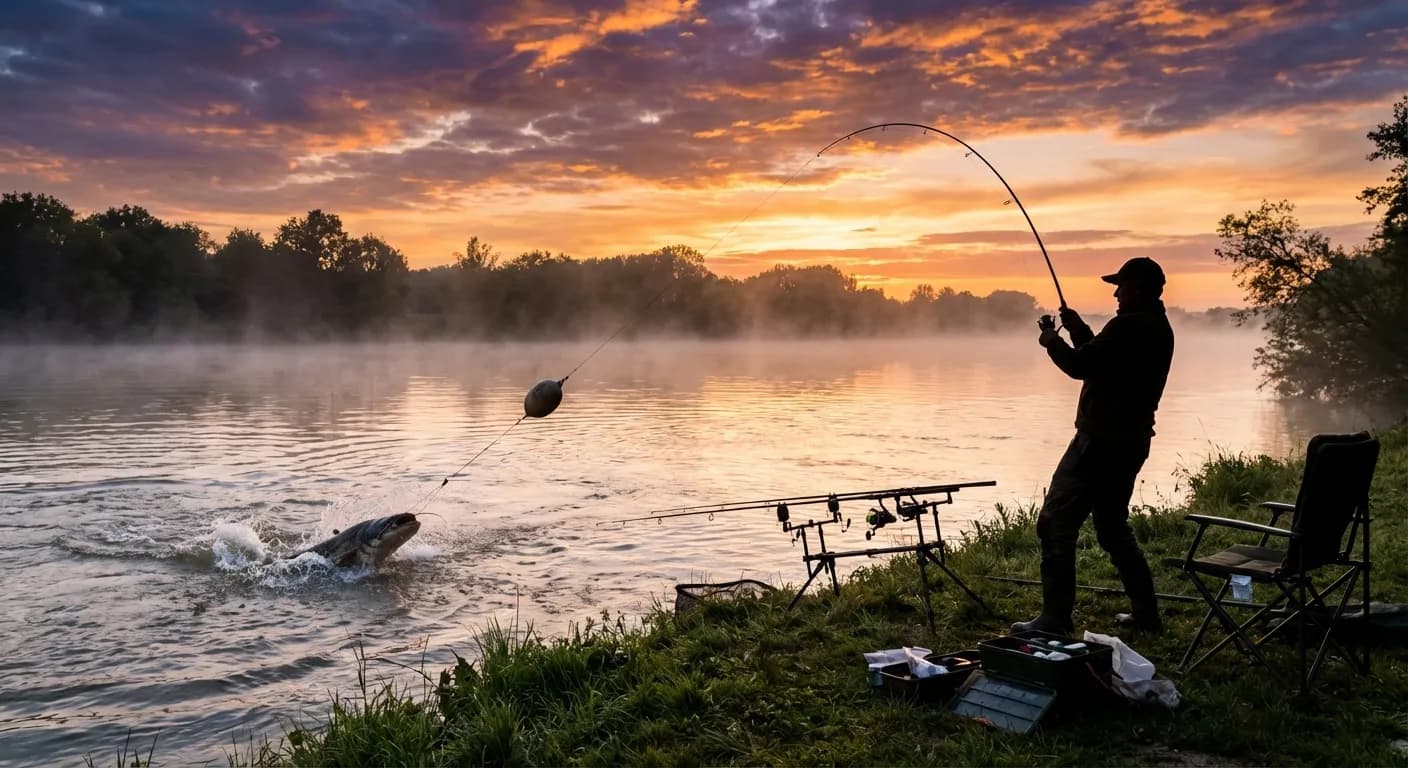
Breakaway catfish fishing
Breakaway catfish fishing
Breakaway catfish fishing is a bank technique that uses a bottom line with a specific setup: the main line is voluntarily "breakable" (low breaking strain) to allow the catfish to escape in case of snag, thus avoiding the fish drowning. This ethical and technical approach is prized by experienced catfish anglers who target large specimens from the bank.
On the Lot at Aiguillon, the breakaway finds its ideal terrain. Accessible banks, nearby holes and the presence of 2-metre-plus catfish make it a prime spot. The private pontoon of Gîte du Martin Pêcheur offers an additional spot for this technique. Hamid, your host, practises the breakaway and can pass on the subtleties of the setup and spot choice. Long sessions (12-48 h) are the norm for this waiting fishing.
What you need
Catfish rods 3.60 to 4.20 m
200-300 g casting, parabolic action. Long rods for distance casting and controlling fights from the bank.
Big pit or casting reels
250 m capacity minimum. Main line in 35/100 mono (breakable) fixed on a reserve. Hooklink in braid or stronger fluorocarbon.
Breakable line (30-35/100 mono)
The main line must break before the hooklink in case of snag. 8-12 kg breaking strain. It protects the catfish in case of snag.
Breakaway setup (swivel, lead, hooklink)
Fixed or sliding lead 100-150 g. 60-80 cm hooklink in 50 lb braid or fluorocarbon. Treble or single hooks according to regulations.
Baits and bite alarms
Live bait, dead fish or large lure. Electronic bite alarms for long sessions. Rod pod or banksticks to hold rods.
Rigging and practice
Understand the breakaway principle
The main line (breakable) connects the rod to the setup. If the catfish snags (tree, rock), the line breaks before the hooklink. The catfish keeps the setup but can survive. The hooklink will eventually degrade. It's responsible fishing.
Assemble the setup
Fix the breakable line to the reel. Pass it through the swivel, add the lead. The hooklink (strong) carries the hook and bait. Check the breakable line is the weak point of the setup.
Choose the spot
From the pontoon of Gîte du Martin Pêcheur or the bank, target holes at 50-100 m. Catfish move at the edge of channels. Avoid overly cluttered zones (snag risk).
Cast and monitor
Cast the setup beyond the target zone, then retrieve to position. Tighten the line and set the alarms. Sessions can last 12 to 48 hours. Check baits regularly.
Handle the take and fight
The take can be violent. Let it run a few seconds if needed. Strike and fight keeping the catfish away from obstacles. A 2 m catfish from the bank requires space and composure.
Practice this technique with us
Gîte du Martin Pêcheur, on the Lot at Aiguillon, offers a private pontoon and access to the Lot-Garonne confluence. The breakaway is ideally practised from these spots. Hamid, your host, knows the holes and zones where 2-metre-plus catfish hold. Long sessions (12-48 h) are facilitated by lodge comfort. The breakaway technique requires experience; Hamid can help you with setup and spot choice.
Book your stayCommon mistakes
Breakable line too strong
The breakable line must be the weak point. If too strong, the catfish stays snagged. Use 30-35/100 mono (8-12 kg breaking strain).
Spot too cluttered
Avoid zones with branches, rocks or dense weed. A snagged catfish complicates the fight and goes against breakaway ethics.
Neglecting monitoring
Dead bait or tired live bait gives nothing. Check every 4-6 hours. Alarms alert you, but manual check remains useful.
Striking too early
The catfish can chew the bait. Wait for a clear run or prolonged take before striking. Patience avoids missed strikes.
Your questions about this technique
Why "breakaway"?
The main line is voluntarily weaker than the hooklink. In case of snag, it breaks first, allowing the catfish to leave with the setup rather than staying snagged and dying.
Is the breakaway allowed everywhere?
Yes, on the Lot. However check local regulations. Some fishing associations impose rules on setups or hooks.
What bait for the breakaway?
Live bait (roach, bream), dead fish (lamprey, mackerel head) or large lure. Large baits target large catfish.
How many rods for a breakaway session?
2 to 3 rods maximum. Regulations often limit rod number. From the lodge pontoon, 2 well-placed rods suffice.
Is the breakaway effective at night?
Yes, catfish hunt actively at night. The breakaway works 24/7. Bring discreet lighting and reliable alarms.