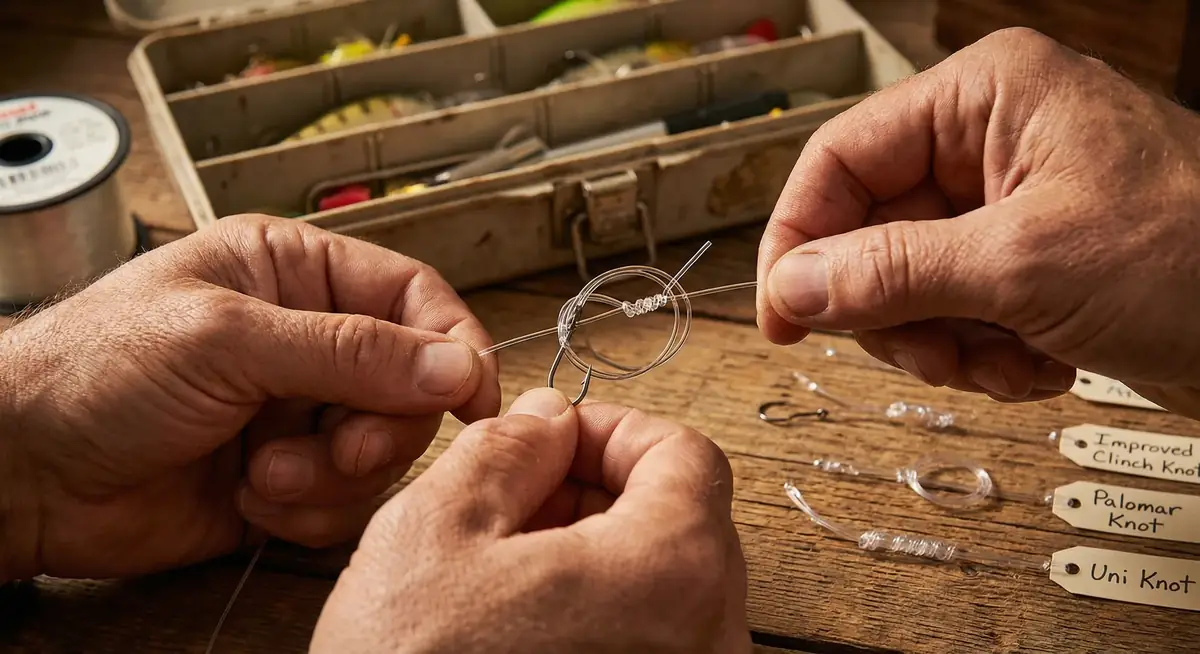
The knot: the critical link
A badly tied knot can cost you the fish of a lifetime. The knot is always the weakest point of your rig: that is where line strength drops, where breakage occurs during a run. A good knot retains 85 to 95% of the line's nominal strength. A bad knot, poorly tightened or poorly tied, can drop to 50% or less. In carp fishing, where every catch counts and fights can be long, knot reliability is non-negotiable. Take the time to master three or four knots perfectly rather than knowing ten badly. Repetition and practice in real conditions make the difference.
80% of drop-offs are due to a badly tied knot. Take the time to master 3–4 knots rather than knowing 10 badly.
The knotless knot
The knotless knot is THE carp angler's knot. Used for the hair rig, it is simple to tie and extremely reliable. It retains over 90% of line strength and works with all line types: monofilament, braid and fluorocarbon. It is the first knot to learn in carp fishing. Its main advantage: it allows easy adjustment of hair length by sliding the knot before final tightening. The hair rig with knotless knot offers natural bait presentation and excellent strength on the take. Once mastered, you will use it on the vast majority of your rigs. It is the essential knot for attaching the hook to the leader in a classic hair rig.
The Palomar knot
The Palomar knot is the strongest for attaching a swivel: it retains about 95% of line strength. Very simple to tie in three steps, it works perfectly with monofilament and braid. It is the ideal knot for connecting the rig to the lead swivel. Its simplicity makes it the knot of choice when reliability matters: on rivers, during intense fights, or when you want to be sure your attachment will hold. The Palomar is quick to tie even in the dark or in cold weather, when fingers are less agile. A must-have in the carp angler's toolkit.
The Grinner (Uni knot)
The Grinner knot, also called Uni knot, is versatile: it can serve as an attachment knot (hook, swivel) or as a joining knot between two lines. It offers good strength of 85 to 90% and tightens progressively without jerking, which preserves line integrity. It works particularly well with fine braid, where other knots can slip. The Grinner is the ultimate backup knot: when the Palomar or knotless do not suit, the Grinner does the job. Easy to remember and tie, it deserves its place in your knot box.
The Albright knot
The Albright knot is the joining knot par excellence. It is used to connect monofilament to braid or monofilament to fluorocarbon, for leaders. Its advantage: it is compact and passes easily through rod rings without snagging. It retains excellent strength and stays discreet underwater. Ideal for fluorocarbon leaders connected to main braid or monofilament, the Albright is a technical but essential knot as soon as you use different line combinations. Once mastered, you will use it on all your leader rigs.
Other useful knots
Four complementary knots to know:
- 1Loop knot: To create a loop at the end of the line, useful for quick rig changes and hook changes without redoing the whole rig.
- 2Surgeon's knot: Quick join between two lines of similar diameter, simple and effective for leaders.
- 3Rig loop knot: For multi-hook feeder rigs, allows attaching several hooks on the same line.
- 4FG knot: The best braid-to-fluoro join but technical to tie. For experienced carp anglers seeking maximum discretion.
Tips for perfect knots
Five golden rules for reliable knots:
- 1Always wet the line before tightening to reduce friction and heat that weakens monofilament.
- 2Tighten progressively and firmly, no jerking that could create weak points.
- 3Cut the excess to 1–2 mm, not flush, to avoid knot slippage.
- 4Test each knot by pulling firmly before fishing, especially on critical rigs.
- 5Retie the knot at the slightest doubt: better to lose 30 seconds than a fish.